fidari
For payers

The measurement layer that makes value-based oncology work

You can’t manage oncology costs without knowing what’s happening between appointments. Fidari captures the real-time navigation, barrier, and outcome data that makes value-based contracts actually measurable.

You’re paying for outcomes you can’t measure

Value-based oncology contracts promise shared savings for better outcomes. But most payers lack the real-time infrastructure to know which patients are high-risk, which interventions are working, and whether total cost of care is actually decreasing. Claims data arrives months late. EHR data stays locked inside provider walls. The result is contracts built on assumptions rather than evidence.

What you can’t see today

  • Which patients are at risk of dropping out of treatment
  • What barriers are causing avoidable ER visits
  • Whether navigation and supportive care are actually being delivered
  • Which interventions reduce utilization and which don’t
  • How symptoms evolve between clinical encounters
  • Whether referrals to supportive services were completed

Real-time data from the point of care

Know which patients are high-risk before they show up in the ER

Fidari captures symptom trends, missed appointments, unresolved barriers, and adherence signals continuously. These real-world signals surface risk earlier than claims data ever could, giving your care management teams and provider partners time to intervene.
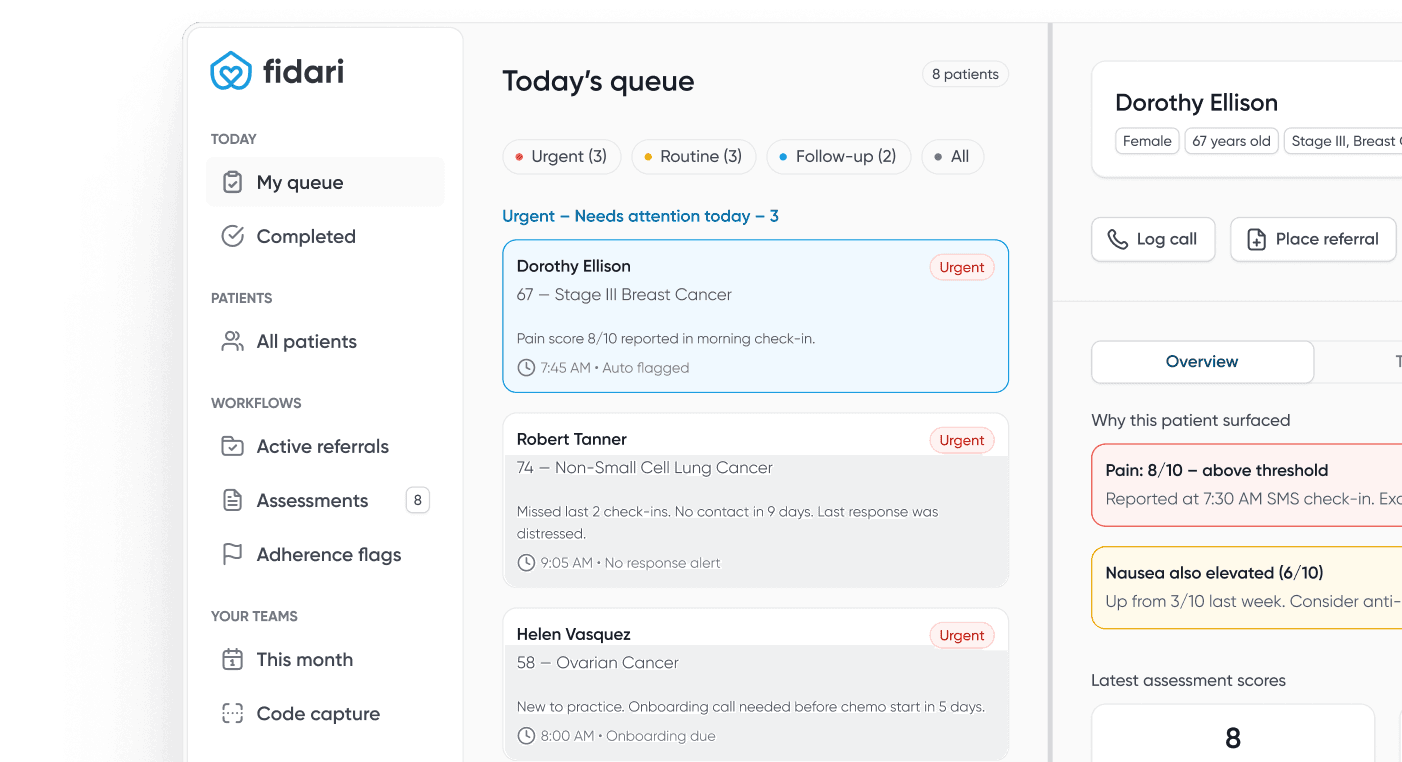
Fidari navigator dashboard showing today's urgent patient queue

Measure whether care coordination is actually happening

Most value-based contracts require care coordination, but there’s no way to verify it’s being delivered. Fidari documents every navigator touchpoint, referral, and intervention in structured data. You get evidence of coordination, not just attestation.

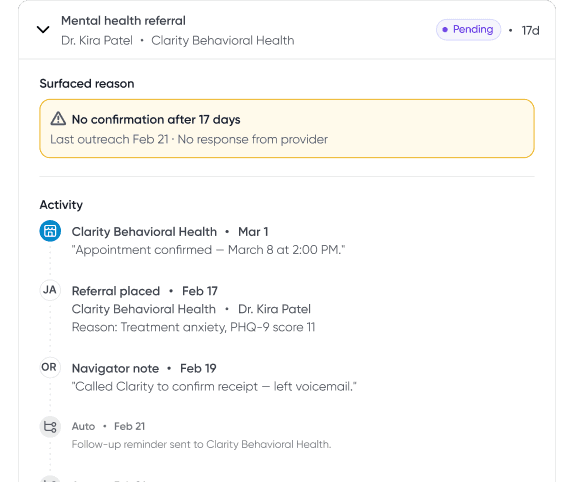
Fidari referral activity timeline showing provider outreach

Connect interventions to outcomes

Fidari links navigation activity and barrier resolution to downstream utilization and treatment outcomes. When a patient gets connected to transportation and stays on therapy, you can see the causal chain. When they don’t, you can see where it broke.

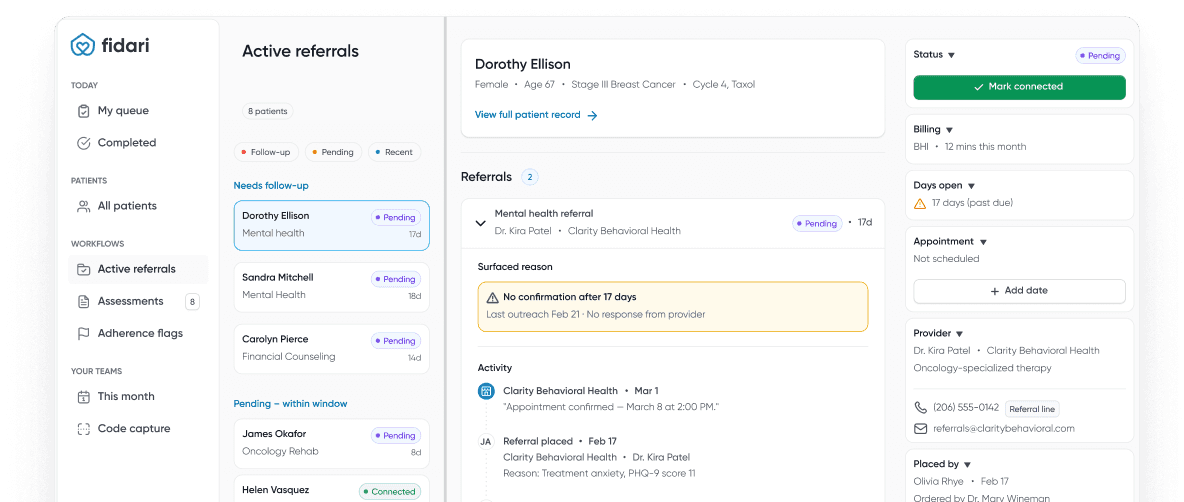
Fidari active referrals dashboard with patient detail

Flexible engagement models

Fidari sits between providers and payers as the shared data infrastructure that makes oncology contracts work for both sides. We're exploring partnerships with payers across several models.

  • Data and analytics

    Access de-identified, aggregated data on navigation patterns, barrier prevalence, and intervention effectiveness across Fidari's provider network. Use it for network strategy, program design, or actuarial modeling.

  • Value-based contract infrastructure

    Use Fidari as the measurement layer for oncology VBC contracts. Real-time tracking of care coordination activity, quality measures, and cost-of-care metrics shared between you and your provider partners.

  • Shared savings participation

    As Fidari-enabled practices demonstrate reduced avoidable utilization and improved adherence, we can structure shared savings arrangements that align incentives across all parties.

Let's explore what Fidari data could mean for your oncology strategy

We're working with health systems and community oncology practices to build the data infrastructure that value-based oncology has been missing. If you're thinking about how to make oncology contracts work better, we should talk.